

The global macroeconomic landscape is currently marked by increasing uncertainty, leading to heightened volatility across the electronics industry. Fears of extended high interest rates and an economic slowdown are weighing on investor sentiment, with a distinct downturn in major technology stocks. Let's explore the current market trends and key indicators through JADISS market analysis.
Keywords
Flow
Shorts
The prevailing global macroeconomic environment, characterized by persistent high interest rates and concerns about an economic slowdown, is significantly impacting the technology-driven electronics industry. The prospect of central banks in major economies maintaining tight monetary policies for longer is dampening corporate investment sentiment and reducing overall consumer spending power. This negatively affects demand for high-growth semiconductors and IT products, raising caution about a general slowdown in the industry's growth trajectory.
These macroeconomic pressures are propagating throughout the entire electronics industry value chain. The semiconductor industry, in particular, is experiencing simultaneous inventory adjustments and demand contraction, leading to downward price pressure. This affects not only memory semiconductor manufacturers but also related equipment and component suppliers. In the end-product market, shipments of key IT devices such as smartphones, PCs, and home appliances continue to decline, indicating a spread of weakness from upstream to downstream industries.
Analyzing the supply and demand dynamics among market participants, foreign investors have shown sustained selling in leading electronics stocks, exerting downward pressure on the market. In contrast, domestic institutional investors have maintained limited buying positions, absorbing some of the selling volume, while individual investors have shown inflows, viewing the situation as an opportunity for bargain hunting. Although the short selling ratio has recently decreased slightly, it continues to reflect market uncertainty and contribute to volatility, necessitating a cautious approach even during potential short-term technical rebounds.
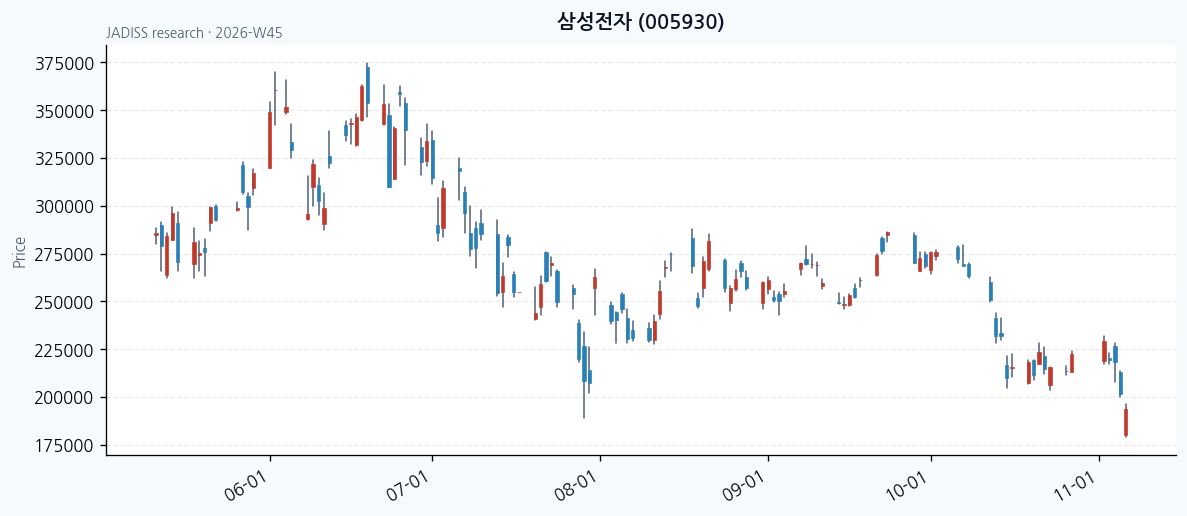
Currently, stock prices have seen significant declines over 5-day and 20-day periods, approaching the lower Bollinger Band. The Relative Strength Index (RSI) has entered oversold territory, and the MACD indicator also shows a bearish signal with a downward trend. While this suggests a possibility of a short-term technical rebound, the overall downward pressure remains strong.
We will observe and monitor further market changes if clear signals of global economic recovery emerge and signs of forward demand recovery for semiconductors and IT products are confirmed. A conservative approach remains prudent until expectations for improved earnings from major technology companies are established.
Consider reducing exposure or selling if concerns about a global economic recession intensify, or if semiconductor inventories increase more than expected, leading to sustained price pressure. Risk management is also necessary if foreign investors accelerate large-scale outflows and key support levels are breached.
If this hits
- 글로벌 인플레이션 완화 및 금리 인하 기대감 확산
- 인공지능(AI) 및 고성능 컴퓨팅(HPC) 수요 증가로 인한 반도체 업황 개선
- 주요국 정부의 반도체 및 첨단 기술 산업 육성 정책 강화
- 신규 스마트폰 및 IT 기기 출시를 통한 전방 수요 회복
If this breaks
- 예상보다 빠른 금리 인상 재개 또는 장기화
- 글로벌 경기 침체 심화 및 소비 심리 추가 위축
- 지정학적 리스크 고조로 인한 공급망 불안정성 확대
- 주요 기업들의 실적 부진 발표 및 가이던스 하향 조정
Watch
- 미국 소비자물가지수(CPI) 및 연방공개시장위원회(FOMC) 결과
- 글로벌 반도체 기업들의 재고 수준 및 출하량 추이
- 주요 IT 제품(스마트폰, PC, 서버)의 판매 동향 및 신제품 출시
- 환율 변동성 및 국제 유가 등 원자재 가격 추이
- 외국인 및 기관 투자자들의 수급 변화
Value chain
- 반도체 설계 및 제조 (파운드리, 메모리)
- 디스플레이 패널 및 모듈
- 스마트폰, PC, 태블릿 등 완제품
- 가전제품 (TV, 냉장고 등)
- 전장 부품 및 자율주행 기술
View
Related
Macroeconomic Headwinds and Industry-Wide Slowdown
The global environment of sustained high interest rates and economic slowdown concerns is significantly burdening the technology-centric electronics industry. The potential for prolonged tight monetary policies by major central banks is eroding corporate investment confidence and reducing overall consumer spending. This adversely impacts demand for high-growth semiconductors and IT products, raising vigilance about a broader industry growth deceleration. The semiconductor sector faces price pressure from inventory adjustments and reduced demand, while declining shipments of end-user IT devices like smartphones and PCs indicate a ripple effect of weakness from upstream to downstream industries.
Persistent Foreign Selling and Market Dynamics
An analysis of market participant flows reveals that foreign investors have consistently sold off leading electronics stocks, contributing to downward market pressure. Over the last 5 and 20 trading days, they net sold over 2.19 million and 4.83 million shares, respectively. In contrast, domestic institutional investors have maintained limited buying positions, absorbing some of the selling, while individual investors have shown inflows, purchasing over 1.94 million shares in 5 days and 4 million shares in 20 days, indicating bargain-hunting. Although the short selling ratio has slightly decreased, it still reflects market uncertainty and fuels volatility.
Technical Indicators: Potential for Short-Term Rebound Amid Downward Pressure
Current stock prices show substantial declines over 5-day and 20-day periods, nearing the lower Bollinger Band, with drops of 12.94% and 29.89% respectively. The Relative Strength Index (RSI) has entered oversold territory, and the MACD indicator also signals a bearish trend. While these suggest a possibility of a short-term technical rebound, the overall downward pressure remains strong, necessitating a cautious approach. JADISS market research provides detailed analysis of these technical trends.
Next step
JADISS channels
Journal
· Home
· Lab
· Blog
· Telegram
Explore JADISS trading journals and weekly market research for key market trends and trading signals.
JADISS brief · Disclaimer