
The global semiconductor market is witnessing intensifying competition, driven by China's technological pursuit and economic uncertainties. In response, the Korean semiconductor industry is strategically focusing on maintaining its technological leadership and fostering new demand through robust government support and regulatory reforms. JADISS offers insights into the latest semiconductor market trends.
Keywords
Flow
Shorts
The global semiconductor industry is currently experiencing heightened competition, notably with China's advancements in memory technologies like D-RAM. In response, the Korean government is implementing comprehensive policy support and regulatory reforms, including establishing a dedicated organization for semiconductor mega-projects, introducing fast-track permits for fabs, and expanding R&D incentives. This initiative aims to elevate the overall capabilities of the semiconductor ecosystem as a national strategic industry.
These shifts in the industrial landscape are expected to have ripple effects across the entire semiconductor value chain. Particularly in areas such as automotive semiconductors, a 'one-team' collaborative system is being established among domestic companies, accelerating localization and strengthening the ecosystem. Furthermore, technology sharing from large corporations to small and medium-sized enterprises (SMEs) in materials, parts, and equipment (MPE) can enhance technological self-reliance and support robust growth across the industry.
While some views suggest potential short-term volatility due to supply-demand imbalances and concerns over memory price declines, the long-term outlook remains positive. New demand drivers such as Artificial Intelligence (AI), high-performance computing, and automotive electronics are expected to propel industry growth. In terms of supply and demand, foreign investor inflows and institutional portfolio shifts will be key variables determining market direction.
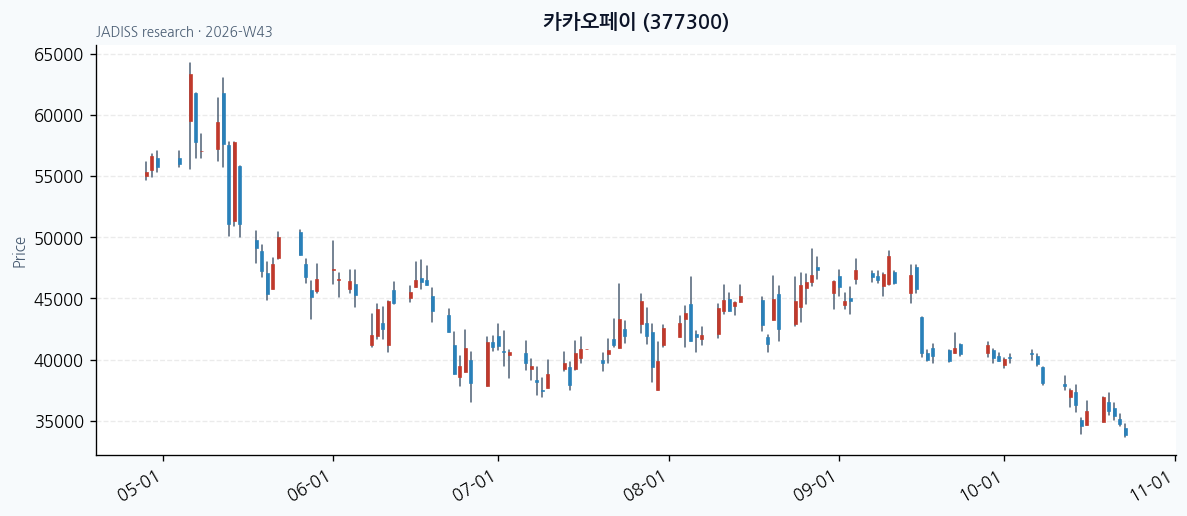
Examining the technical indicators for KakaoPay, the stock price is currently near the lower Bollinger Band, and the RSI has entered an oversold zone. The MACD indicator also shows a downward trend, suggesting both the possibility of a short-term technical rebound and potential for further downward pressure.
If this hits
- 글로벌 IT 수요 회복 및 AI 반도체 시장의 예상치 상회 성장
- 정부의 반도체 산업 지원 정책 구체화 및 실질적인 성과 도출
- 국내 기업들의 차세대 메모리 및 비메모리 기술 개발 성공 소식
If this breaks
- 중국 반도체 기업의 기술력 급성장 및 시장 점유율 확대
- 글로벌 경기 침체 장기화로 인한 전방 산업 수요 위축
- 반도체 재고 증가 및 가격 경쟁 심화
Watch
- 글로벌 반도체 기업들의 분기별 실적 발표 및 가이던스
- 주요국 정부의 반도체 산업 정책 및 무역 규제 동향
- AI, 차량용 등 신규 반도체 수요처의 성장 속도
- 환율 및 금리 등 거시 경제 지표 변화
Value chain
- 메모리 반도체 (D램, 낸드플래시)
- 비메모리 반도체 (시스템 반도체, 차량용 반도체)
- 반도체 소재·부품·장비 (소부장)
- 파운드리 (반도체 위탁 생산)
- 팹리스 (반도체 설계 전문)
View
Related
Korea's Strategic Response to Global Competition
The global semiconductor sector faces intense competition, particularly from China's advancements in memory technology. The Korean government is proactively responding with comprehensive policy support, including dedicated mega-project task forces and fast-track permits, aiming to bolster the entire semiconductor ecosystem as a national strategic asset.
Strengthening the Value Chain and Expanding New Demands
These industry shifts are expected to positively impact the semiconductor value chain. Collaborative 'one-team' systems are emerging for automotive semiconductors, accelerating localization. Furthermore, the expansion of new demand areas like AI, high-performance computing, and automotive electronics is set to drive long-term industry growth.
Navigating Market Volatility and Growth Opportunities
While short-term concerns about supply-demand imbalances and potential price adjustments exist, the long-term outlook for the semiconductor industry remains robust, supported by sustained government policies and fundamental growth drivers. JADISS provides timely market research to help you understand these dynamics.
Next step
JADISS channels
Journal
· Home
· Lab
· Blog
· Telegram
Explore market trends and make informed decisions with JADISS daily trading journals and weekly research briefs.
JADISS brief · Disclaimer