

The explosive growth of Artificial Intelligence (AI) technology and significant data center investments are propelling the global semiconductor market forward. However, the potential for short-term market adjustments and complex supply chain restructuring present new challenges. JADISS meticulously analyzes these critical trends in the semiconductor industry to provide investors with in-depth market insights.
Keywords
Flow
Shorts
The global semiconductor industry is currently at a new turning point, driven by the explosive growth of artificial intelligence (AI) technology and the demand for large-scale data center construction. The increasing need for high-performance AI chips is accelerating the growth of related markets, leading to an overall increase in semiconductor demand. However, some anticipate a temporary market pause, citing the possibility of short-term inventory adjustments or an economic slowdown. Simultaneously, geopolitical factors, such as the intensifying US-China technological rivalry, are prompting a reorganization of the global semiconductor supply chain, exerting complex effects across the industry.
These industrial changes are creating ripple effects throughout the entire semiconductor value chain. Particularly, the memory semiconductor market, centered on High Bandwidth Memory (HBM), is experiencing fierce technological competition, while in the foundry sector (semiconductor contract manufacturing), major companies are intensifying their race to secure advanced process technology. Furthermore, with the growing importance of advanced packaging technology, the role of the back-end processing industry is expanding, and related materials and equipment industries are also seeking co-growth through technological advancement and increased investment. National strategies for semiconductor self-sufficiency are leading to increased investment in specific regions, thereby promoting supply chain diversification.
Key checkpoints for the future of the semiconductor industry include the timing of demand recovery and the advent of a new investment cycle. The scale of government policies and subsidies to foster the semiconductor industry will be a crucial variable in corporate investment decisions. Meanwhile, examining the supply and demand trends of leading semiconductor stocks reveals net selling by foreign and institutional investors over the recent 5 trading days, but foreign net buying has been dominant over a 20-trading day period. This suggests the possibility of long-term buying interest even amidst short-term profit-taking. The short-selling ratio has slightly decreased compared to the 5-day average, yet it still indicates lingering market caution. Corporate shareholder return policies, such as decisions to acquire treasury shares, can act as positive signals to the market.
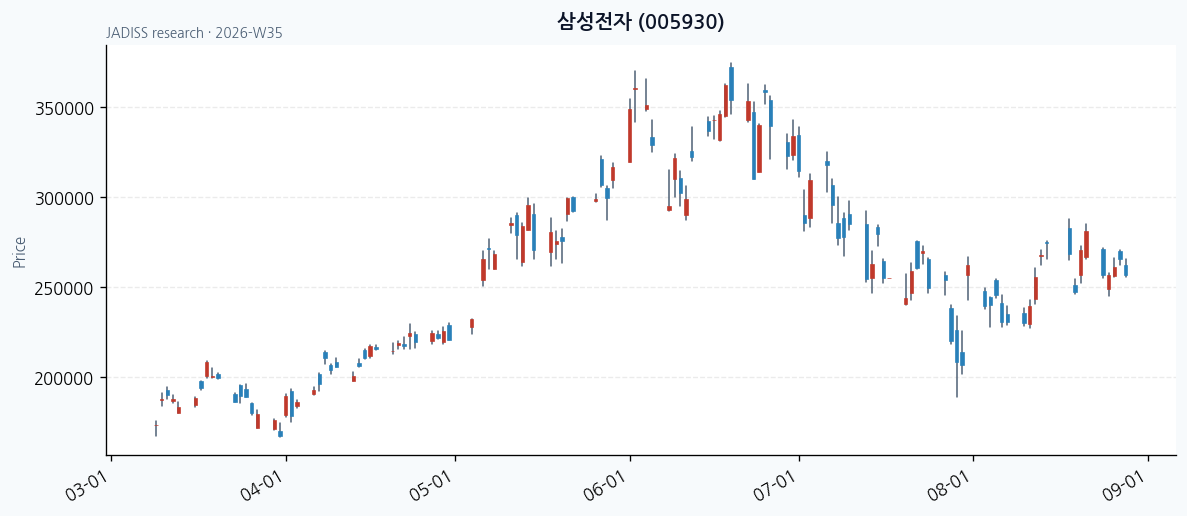
Looking at Samsung Electronics' technical indicators, the RSI 14 is at 58.72, not in an overbought/oversold zone, but it has shown a short-term adjustment trend with an decline over the recent 5 trading days. While the MACD maintains a positive value, the negative MACD signal suggests that upward momentum may be weakening. Although it is positioned above the Bollinger Band middle line (254,200 KRW), the distance to the upper band (284,375 KRW) indicates that further upward potential may be limited.
A positive outlook is maintained if AI-related demand across the semiconductor industry continues to strengthen, and major companies solidify their technological leadership and continue new investments.
Consider reducing exposure if global economic uncertainty intensifies, signs of a delayed semiconductor industry recovery emerge, or technological conflicts between major nations worsen, negatively impacting industry growth.
If this hits
- AI 기술이 산업 전반으로 확산되며 새로운 반도체 수요를 창출할 때
- 클라우드 서비스 제공업체들의 데이터센터 인프라 투자가 예상치를 상회하며 가속화될 때
- 자율주행, 로봇, 사물 인터넷 등 신규 애플리케이션 시장이 본격적으로 개화하며 첨단 칩 수요를 견인할 때
If this breaks
- 글로벌 경기 둔화가 예상보다 심화되어 IT 기기 및 서버 수요가 급격히 위축될 때
- 반도체 제조업체들의 재고 부담이 장기화되거나 예상치 못한 공급 과잉이 발생할 때
- 미중 기술 갈등이 고조되어 주요 반도체 기업들의 생산 및 판매 활동에 직접적인 제약이 가해질 때
Watch
- 주요 반도체 기업들의 분기별 실적 발표와 가이던스 변화
- 글로벌 IT 기업들의 시설 투자(CAPEX) 계획 및 집행 동향
- DRAM, NAND 등 주요 메모리 반도체 제품의 현물 및 계약 가격 추이와 재고 수준
- 주요국 정부의 반도체 산업 지원 정책 변화 및 미중 기술 규제 동향
Value chain
- 반도체 설계 (팹리스): 고성능 AI 칩, 시스템 반도체 설계
- 파운드리 (위탁생산): 미세 공정 기술 개발 및 생산 능력 확대
- 메모리 반도체: HBM, DDR5 등 차세대 메모리 기술 리더십 경쟁
- 반도체 장비 및 소재: 전공정 및 후공정 핵심 장비, 고기능성 소재 공급
View
Related
AI Era Semiconductors: A New Turning Point
The semiconductor industry is experiencing unprecedented growth driven by the surging demand for high-performance AI chips and the accelerated construction of large-scale data centers. Simultaneously, geopolitical factors like the US-China tech rivalry are prompting a global supply chain restructuring, creating complex impacts across the industry.
Intensified Competition Across Value Chains and Strategic Investments
The memory semiconductor market, particularly High Bandwidth Memory (HBM), faces fierce technological competition. In the foundry sector, major players are intensifying their race to secure advanced process technology. The growing importance of advanced packaging is expanding the role of the back-end processing industry, while national semiconductor self-sufficiency strategies are driving supply chain diversification.
Market Supply-Demand Trends and Key Indicator Analysis
Recent observations in leading semiconductor stocks indicate short-term profit-taking, yet also suggest the potential for long-term buying interest. While the short-selling ratio has slightly decreased, market caution persists. Corporate shareholder return policies, such as treasury share acquisitions, can act as positive market signals. JADISS provides market insights by comprehensively analyzing these supply-demand and technical indicators.
Next step
JADISS channels
Journal
· Home
· Lab
· Blog
· Telegram
Don't miss the trends in the global semiconductor industry with JADISS trading journals and market research.
JADISS brief · Disclaimer