

The explosive growth of Artificial Intelligence (AI) is reshaping the semiconductor industry. Surging demand for AI semiconductors, particularly High Bandwidth Memory (HBM), is driving significant capital expenditure by leading companies, presenting both new opportunities and challenges across the entire sector. Explore key trends in the AI semiconductor market and identify crucial signals within this evolving landscape with JADISS.
Keywords
Flow
Shorts
The semiconductor industry is currently undergoing an unprecedented period of change, driven by the rapid advancement of artificial intelligence (AI) technology. In particular, with the explosive increase in demand for AI semiconductors, including High Bandwidth Memory (HBM), major memory manufacturers are aggressively investing in facilities to secure market leadership. This trend goes beyond simple production volume increases, focusing on next-generation technology development and capacity expansion, emerging as a key issue that raises overall industry growth expectations.
These large-scale investments are having ripple effects across the entire semiconductor value chain. The expansion race among memory manufacturers is benefiting downstream industries such as semiconductor equipment, materials, and components, acting as a growth engine for related companies. Furthermore, the increasing complexity of AI chips is further highlighting the importance of foundry technology, and competition for high-performance chip development, such as AI accelerators, is intensifying in the non-memory sector. Meanwhile, the efforts of the Chinese semiconductor industry towards self-sufficiency and technological catch-up are also acting as a new variable in the global competitive landscape, accelerating the overall industry restructuring.
Currently, the semiconductor market is showing a gradual recovery driven by AI demand, but concerns about major companies' aggressive capital expenditures potentially leading to future oversupply still exist. Looking at market supply and demand trends, foreign investors recorded large net purchases over the past five trading days, signaling a positive outlook, while institutions and individuals continued net selling, indicating differing perspectives. The short selling ratio has shown a decrease compared to the last five trading days, suggesting a possible short-term easing of selling pressure. This complex supply and demand situation can be interpreted as a process of finding a balance between the growth potential of the AI semiconductor market and supply risks.
Samsung Electronics' disclosures show recent announcements related to shareholder return policies, such as decisions on treasury stock acquisition, and regular submissions of reports on the ownership status of specific securities by executives and major shareholders. This information can be referenced to understand the company's autonomous management activities and insider trends.
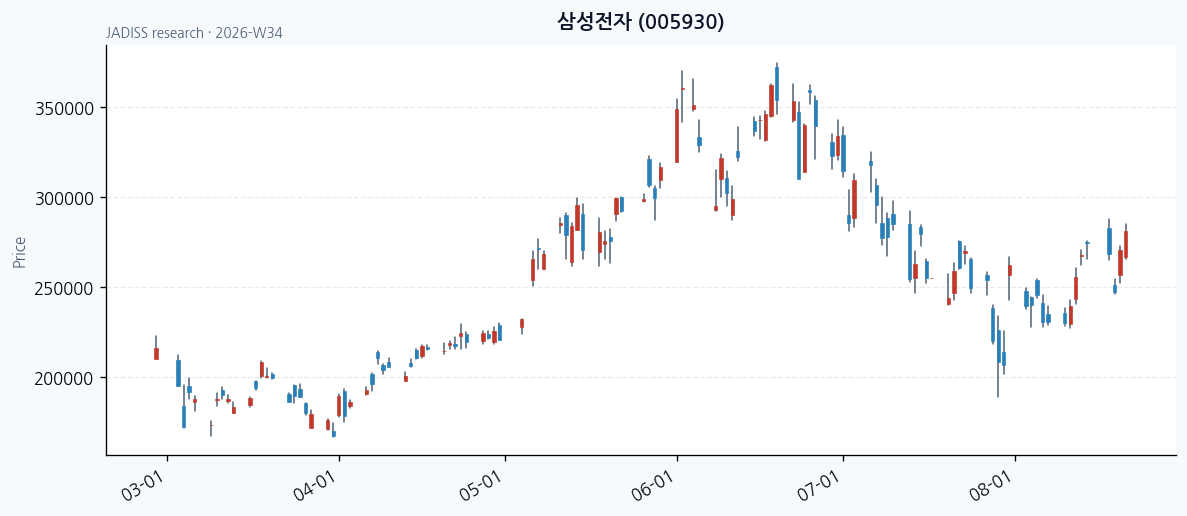
Looking at Samsung Electronics' technical indicators, the RSI14 maintains a neutral level at 56.25, not in overbought/oversold territory. The MACD is above the signal line, forming positive momentum, but the stock price (281,500 KRW) close to the upper Bollinger Band (287,632 KRW) suggests potential short-term price resistance. The %b, which indicates the stock's position relative to the band width, is 0.926, showing that the stock price is very close to the upper Bollinger Band.
In a scenario where AI semiconductor demand remains robust and major companies' increased investments lead to actual performance improvements, it is advantageous to observe the overall positive trend in the industry. Particularly, if positive news about new technology development or expansion into front-end industries continues, a hold perspective can be maintained.
In a scenario where global economic recession deepens or AI investment sentiment weakens, leading to a faster-than-expected slowdown in semiconductor demand, risk management is necessary. Furthermore, if major companies' excessive expansion competition leads to actual oversupply and increased price pressure, a reduction in holdings should be considered, keeping in mind the possibility of an overall industry correction.
If this hits
- 새로운 AI 모델 및 서비스 출시로 인한 반도체 수요의 지속적인 증가
- 데이터센터 및 클라우드 인프라 확장에 따른 고성능 반도체 수요 증대
- 자율주행, 로봇 등 신규 전방 산업의 성장 가속화 및 반도체 채용 확대
- 첨단 패키징 기술 등 차세대 반도체 기술 혁신을 통한 시장 경쟁력 강화
If this breaks
- 글로벌 경기 둔화 심화로 인한 전방 산업 수요 위축 및 반도체 재고 증가
- AI 기술 발전 속도 둔화 또는 투자 축소로 인한 반도체 수요 성장세 둔화
- 주요 기업들의 공격적인 증설 경쟁으로 인한 예상치 못한 공급 과잉 심화
- 미중 기술 갈등 고조 및 반도체 수출 규제 강화로 인한 불확실성 증대
Watch
- 주요 반도체 기업들의 분기별 실적 발표 및 설비투자 계획 변화
- 글로벌 AI 기술 개발 동향 및 신규 AI 서비스 출시 여부
- 메모리 반도체(DRAM, NAND) 및 파운드리 가격 변동 추이
- 주요국 정부의 반도체 산업 육성 정책 및 통상 환경 변화
- 외국인 및 기관 투자자들의 수급 동향과 공매도 비율 변화
Value chain
- 반도체 설계(팹리스): AI 칩, CPU, GPU 등 고성능 시스템 반도체 개발
- 반도체 제조(파운드리): 첨단 공정 기술을 활용한 칩 위탁 생산
- 반도체 장비: 식각, 증착, 검사 등 반도체 생산 공정 필수 장비 공급
- 반도체 소재: 웨이퍼, 포토레지스트, 특수가스 등 생산에 필요한 핵심 재료 공급
View
Related
AI Semiconductors: The Engine of Industry Growth
The rapid evolution of AI technology has ushered in an unprecedented era of change for the semiconductor industry. With the explosive demand for AI semiconductors, particularly High Bandwidth Memory (HBM), leading memory manufacturers are aggressively investing in facilities to secure market dominance. This focus extends beyond mere production increases, emphasizing next-generation technology development and capacity expansion, thereby fueling overall industry growth expectations.
Ripple Effects Across the Value Chain and Market Dynamics
These substantial investments are creating ripple effects throughout the entire semiconductor value chain. The expansion race among memory manufacturers is benefiting downstream industries like equipment, materials, and components, acting as a growth driver for related companies. While foreign investors showed significant net purchases and the short-selling ratio decreased over the past five trading days, institutions and individuals presented mixed views, reflecting the complex supply and demand dynamics of the market.
Technical Insights into the Current Market
Examining technical indicators for Samsung Electronics reveals that the RSI14 maintains a neutral level, and the MACD shows positive momentum. However, the stock price's proximity to the upper Bollinger Band suggests potential short-term price resistance. These indicators offer crucial clues for understanding the short-term market movements alongside the long-term growth potential of the AI semiconductor market.
Next step
JADISS channels
Journal
· Home
· Lab
· Blog
· Telegram
Stay ahead in the evolving AI semiconductor industry. Leverage JADISS trading journals and market research to understand market flows and capture critical signals.
JADISS brief · Disclaimer