

- JADISS research + marketing layer
- Keywords: JADISS · research · trading journal
- Portal: research #28
The semiconductor industry is navigating a period of short-term correction, yet the underlying currents of AI innovation and surging data center demand continue to fuel its long-term growth. How should investors interpret the current market uncertainties and position themselves for the future? Dive into JADISS's market insights to understand the present and future landscape of the semiconductor sector.
The semiconductor industry has recently experienced short-term downward pressure, stemming from a general cooling of tech stock investment sentiment across the market and concerns over economic slowdowns in specific countries. Notably, the share prices of major memory semiconductor companies have seen recent declines, accompanied by selling from foreign and institutional investors and a significant increase in short interest. Despite this, the proliferation of Artificial Intelligence (AI) technology and robust demand for high-performance computing continue to sustain long-term growth expectations for the industry.
The semiconductor industry's value chain is extensively interconnected, encompassing memory, foundry, and system semiconductors, as well as the equipment and material companies that produce them. Current key issues include memory inventory levels and price volatility, with the timing of supply-demand balance recovery in the DRAM and NAND flash markets being particularly crucial. Meanwhile, China's efforts to strengthen its domestic semiconductor production capabilities introduce a new variable into the global supply chain, presenting both opportunities and intensified competition for domestic material, component, and equipment companies.
Future scenarios for the semiconductor industry broadly fall into two categories. First, if AI demand accelerates faster than expected and the replacement cycle for existing IT devices arrives, leading to faster inventory depletion, the industry could recover quickly. Second, if the global economic slowdown prolongs or geopolitical risks intensify, demand recovery could be delayed, and industry sluggishness might persist. Currently, foreign and institutional investors are net sellers, adopting a wait-and-see approach, while individual investors show a net buying preference. The elevated short interest reflects the market's short-term caution.
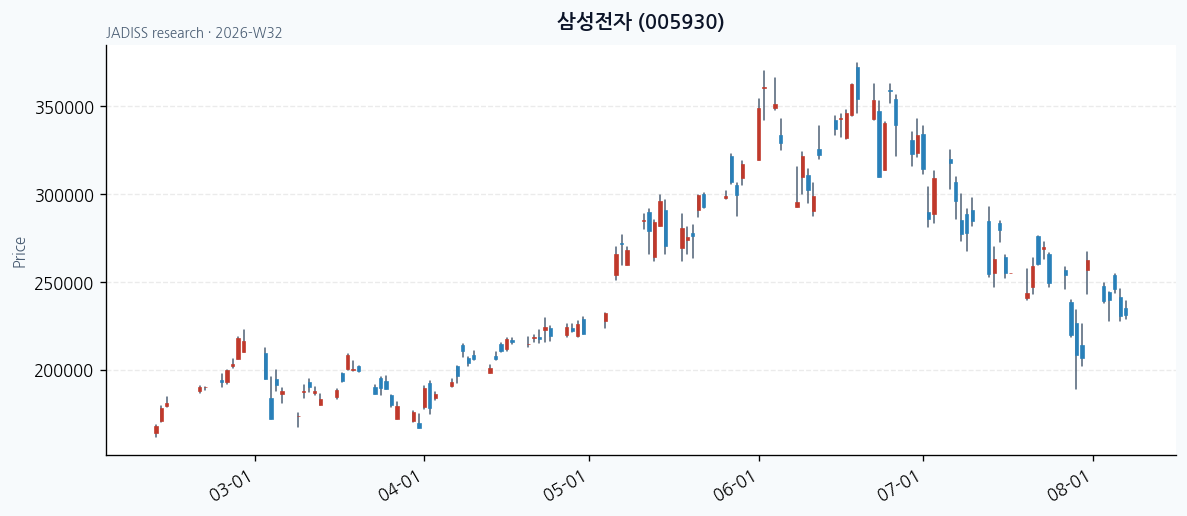
Examining the overall technical indicators for the semiconductor industry, Samsung Electronics' stock price has shown a downward trend, with negative 5-day and 20-day returns. The Relative Strength Index (RSI) stands at 46.73, not indicating overbought/oversold conditions, but the MACD indicator remains negative, suggesting a bearish trend. According to Bollinger Bands, the stock price is below the middle band and approaching the lower band, indicating a need to monitor short-term volatility expansion.
Samsung Electronics' stock price recorded returns of -12.0% over 5 days and -18.95% over 20 days, indicating a downward trend. An RSI of 46.73 is neutral, but the MACD is below its signal line, suggesting a short-term bearish trend. The stock's proximity to the lower Bollinger Band suggests potential short-term oversold conditions, but additional momentum is needed for a trend reversal.
If confidence in the long-term AI growth drivers of the semiconductor industry is maintained, and signs of inventory depletion and price rebound appear for major companies, the current short-term correction could be viewed as an attractive entry opportunity, warranting a wait-and-see approach.
If the global economic recession deepens more than expected, or if the growth rate of AI demand slows and memory semiconductor prices continue to fall, or if geopolitical risks significantly impact the supply chain, a reduction in holdings or selling could be considered.
Navigating Current Semiconductor Market Dynamics
The semiconductor industry is currently experiencing short-term headwinds, driven by a broader cooling of tech investment sentiment and economic uncertainties in key regions. Major memory semiconductor stocks have seen declines, with increased selling by foreign and institutional investors and a rise in short interest signaling market caution. Monitoring memory inventory levels and price volatility, particularly for DRAM and NAND flash, is crucial as the market seeks a new supply-demand equilibrium.
AI's Enduring Impact and Future Scenarios for Semiconductors
Despite immediate pressures, the expansion of Artificial Intelligence (AI) and robust demand for high-performance computing remain the core long-term growth drivers for the semiconductor industry. Future scenarios could see a rapid recovery if AI demand accelerates and IT device replacement cycles deplete existing inventories. Conversely, a prolonged global economic slowdown or intensified geopolitical risks could delay recovery. JADISS provides insights into these complex scenarios, helping you understand the industry's potential paths.
Empowering Your Investment Decisions with JADISS
While technical indicators suggest potential short-term volatility in the semiconductor sector, the long-term conviction in AI-driven growth persists. JADISS offers educational market research to help investors make informed decisions amidst these intricate market movements. Whether to view the current correction as an attractive entry point or to consider reducing exposure depends on key market signals. Utilize JADISS's trading journals and market analysis to gain insights for prudent investment choices.
Evidence (JADISS synthesis)
- Foreign and institutional investors were net sellers of Samsung Electronics shares over the past 5 and 20 days, while individual investors were net buyers.
- Samsung Electronics' short interest ratio recently increased significantly to 11.39% compared to its 20-day average, reflecting short-term downward pressure.
- SK Hynix's large-scale capital expenditure plans indicate a positive outlook for future semiconductor demand.
- Some market analyses suggest the semiconductor industry, despite short-term adjustments, could reattempt new highs by the first half of 2027, anticipating a long-term upward cycle.
- PC manufacturers have begun using chips from Chinese memory maker CXMT, raising the possibility of changes in the competitive landscape.
Hold view
If confidence in the long-term AI growth drivers of the semiconductor industry is maintained, and signs of inventory depletion and price rebound appear for major companies, the current short-term correction could be viewed as an attractive entry opportunity, warranting a wait-and-see approach.
Trim / exit view
If the global economic recession deepens more than expected, or if the growth rate of AI demand slows and memory semiconductor prices continue to fall, or if geopolitical risks significantly impact the supply chain, a reduction in holdings or selling could be considered.
Related names · tech snapshot
Related: 삼성전자, 광무, 닷밀, 동양 (chart focus: 삼성전자)
Close 231,000 · RSI 46.73 · 5D -12.00% · 20D -18.95%
Next step
JADISS channels
Journal
· Home
· Lab
· Blog
· Telegram
Seeking deeper analysis and strategies for the semiconductor industry? Explore JADISS's weekly research briefs on our portal and develop your investment principles with our condition-signal trading journals. All content is for educational purposes only and not investment advice. Visit jadiss-lab.com today!
JADISS · Disclaimer