

- JADISS research + marketing layer
- Keywords: JADISS · research · trading journal
- Portal: research #22
The explosive growth of Artificial Intelligence (AI) is injecting new vitality into the semiconductor industry. While surging demand for High Bandwidth Memory (HBM) and innovative opportunities for post-processing and SooBujang companies are emerging, global economic slowdowns and geopolitical risks continue to fuel market volatility. Join JADISS as we analyze the complex dynamics of the semiconductor industry in the AI era and explore smart investment strategies.
The semiconductor industry has recently entered a new growth phase, driven by the explosive development of AI technology and a surge in demand for high-performance semiconductors like High Bandwidth Memory (HBM). However, this growth is accompanied by increased industry volatility due to concerns over a global economic slowdown, potential short-term oversupply in specific items, and intensifying geopolitical risks such as the US-China tech competition. While debates about a 'peak-out' are emerging, AI-centric structural demand is considered a key long-term driver for industry growth.
The increase in AI semiconductor demand goes beyond simply boosting memory chip production; it necessitates innovation across the entire post-processing (packaging) technology and the materials, parts, and equipment (SooBujang) industries. The importance of advanced packaging technologies for realizing complex high-performance semiconductor structures is particularly highlighted, amplifying the role of related equipment and material companies. Furthermore, China's efforts towards semiconductor self-sufficiency present new market opportunities for domestic companies in certain areas, while also posing the long-term challenge of global supply chain restructuring. Establishing stable power supply infrastructure is also gaining attention as an essential factor for expanding semiconductor production capacity.
The semiconductor industry currently faces a scenario where long-term AI demand growth coexists with short-term inventory adjustments and weakened investment sentiment. While major companies' capital expenditure plans remain aggressive, short-term stock price corrections reflecting market concerns may be unavoidable. In terms of supply and demand, foreign investors have shown a net selling trend over the past 20 days, but institutional investors have maintained net buying, reflecting a long-term perspective. The short-selling ratio has slightly increased, which can be interpreted as a reaction to short-term market volatility. Overall investment sentiment has somewhat weakened due to China-related headwinds, but the prevailing view is that core demand remains robust.
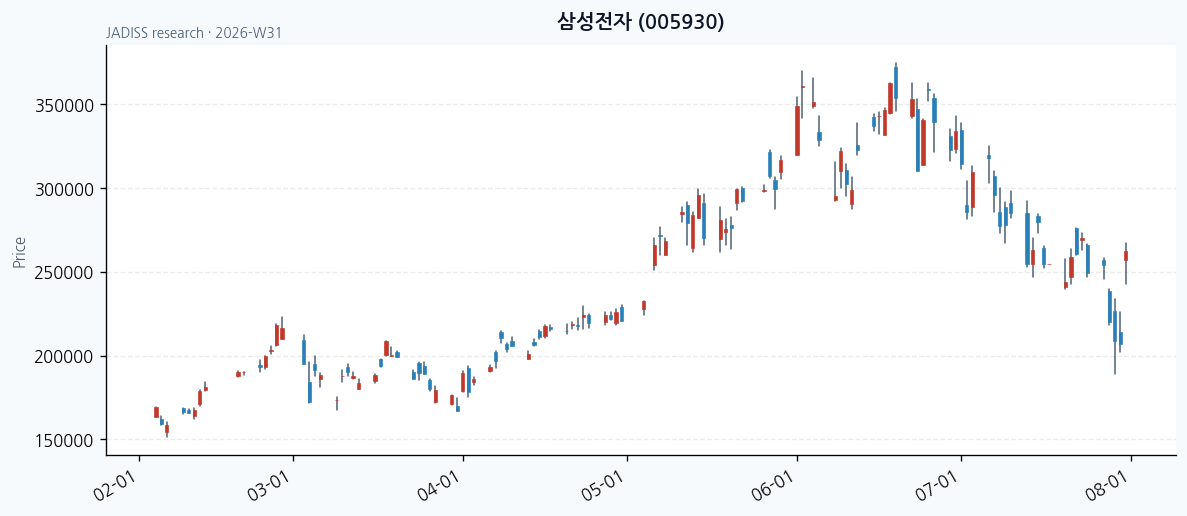
Samsung Electronics' stock price has declined over the past 20 days but rebounded over the last 5 days, showing a short-term recovery. The RSI remains at a neutral level, and the MACD is still below the signal line, making it premature to confirm a trend reversal. Positioned near the Bollinger Band middle line, the stock appears to be exploring its short-term direction.
AI Demand Surge: Reshaping the Entire Semiconductor Value Chain
The advancement of AI technology is not just increasing demand for memory semiconductors; it's also highlighting the importance of advanced packaging technologies and the materials, parts, and equipment (SooBujang) industries for realizing high-performance semiconductors. High Bandwidth Memory (HBM), in particular, requires complex structures, amplifying the role of related equipment and material companies. China's efforts toward semiconductor self-sufficiency also offer new market opportunities for domestic companies in specific areas, while the importance of establishing stable power supply infrastructure is also being emphasized amidst global supply chain restructuring.
Investment Sentiment Amidst Volatility: Divergent Views of Foreign and Institutional Investors
The semiconductor industry currently faces a complex situation where long-term AI demand growth coexists with short-term inventory adjustments and weakened investment sentiment. Over the past 20 days, foreign investors have shown a net selling trend, while institutional investors have maintained net buying, reflecting a long-term perspective. Although the short-selling ratio has slightly increased, this can be interpreted as a reaction to short-term market volatility. Overall investment sentiment has somewhat weakened, but the prevailing view is that core AI-driven demand remains robust. JADISS weekly research briefs can help you grasp these subtle market dynamics.
Samsung Electronics Stock Performance and Outlook
Samsung Electronics' stock price has declined over the past 20 days but rebounded over the last 5 days, showing a short-term recovery. The RSI remains at a neutral level, and the MACD is still below the signal line, making it premature to confirm a trend reversal. Positioned near the Bollinger Band middle line, the stock appears to be exploring its short-term direction. If the structural growth of AI semiconductor demand continues and major companies' new technology development and investment plans proceed without faltering, a hold stance can be maintained, seeing the overall growth potential of the industry despite short-term market volatility. Conversely, a deepening global economic recession, surging inventories, or intensifying US-China tech conflicts could warrant considering reducing holdings or selling.
Evidence (JADISS synthesis)
- Recent corporate disclosures included decisions on cash dividends and preliminary earnings announcements.
- Foreign investors were net sellers over the past 20 days, while institutional investors maintained net buying.
- Over the past 5 days, foreign net selling decreased, and institutional net buying increased.
- The short-selling ratio slightly increased compared to the 20-day average.
- The possibility of geopolitical repercussions on memory semiconductor prices amidst the AI data center construction race was raised.
- China's ChangXin Memory Technologies (CXMT) large-scale fundraising is expected to benefit Korean post-processing material companies.
- Analysis suggests memory shortages could intensify until 2028.
- Expansion of power supply infrastructure is highlighted as crucial for semiconductor production.
Hold view
If the structural growth of AI semiconductor demand continues and major companies' new technology development and investment plans proceed without faltering, a hold stance can be maintained, seeing the overall growth potential of the industry despite short-term market volatility. This is especially positive if gradual recovery signals for memory prices appear.
Trim / exit view
If the slowdown in demand from front-end industries due to a global economic recession deepens more than expected, or if semiconductor inventories rapidly increase, leading to intensified price pressure, or if US-China tech conflicts worsen, causing severe disruptions in the supply chain, the overall growth momentum of the industry could weaken, warranting consideration of reducing holdings or selling.
Related names · tech snapshot
Related: 삼성전자, 광무, 닷밀, 동양 (chart focus: 삼성전자)
Close 262,500 · RSI 51.87 · 5D +5.21% · 20D -15.19%
Next step
JADISS channels
Journal
· Home
· Lab
· Blog
· Telegram
Navigate the complex currents of the semiconductor market with JADISS. Our weekly research briefs and trading journals empower you to establish your own investment principles and experience strategies that outperform the market. Discover more at jadiss-lab.com today!
JADISS buy/sell signal journal · Disclaimer